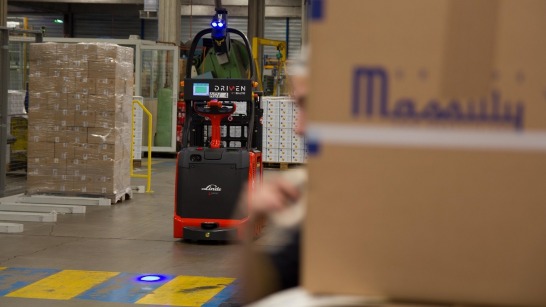
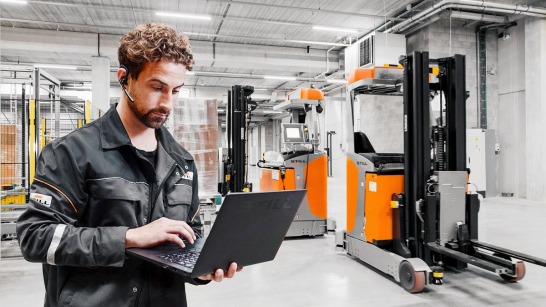
Workers are becoming scarce and expensive in China too, forcing more and more companies to automate their warehouses and distribution systems. Dematic’s customers are mainly involved in clothing, food and pharmaceuticals and in China’s booming e-commerce sector. One of its biggest customers is the clothing chain Heilan Home, which has more than 5,000 stores. In just one Heilan Home warehouse, the total length of Dematic conveyor belts comes to 20 kilometres.
Dematic’s Chinese headquarters are in Shanghai. In nearby Suzhou, the company makes hardware for stacker cranes and conveyor belts. Demand is strongest for automatic high-bay storage facilities, which can reach up to 40 metres in height, high-speed conveyance and sorting systems, and complex one-stop solutions. Only a handful of companies have as much experience in these areas as Dematic. Interest is also growing in what’s known as goods-to-person picking, in which the storage bins are sent at high speed to a sorting station, where workers pick out the goods that are needed for specific customer orders.
Every industry places different demands on intralogistics. “We have zero tolerance for errors. Any time that we deliver medication to the wrong person could prove fatal,” says Zhu Fan. “And because the goods are so valuable, Le Ren Tang also cannot tolerate any downtime.” So the system has to be very reliable.” Zhu is full of praise for Dematic’s maintenance service: “Engineers are always available to speak to and they visit twice a year to do a general service.
Dematic is on a clear path of growth in China and is aiming for market leadership. To achieve this, it’s important that the products are more closely aligned to local needs – and not only so that they can be supplied more cheaply. At Dematic they know that demanding Chinese customers expect the software and the engineering to be localised, for example in terms of language.
_image_1920x400.jpg)
_image_519x291.jpg)
/(a-New-Era)/technical/new_era_element_red_svg.svg) Zhu Fan
Zhu Fan
_image_1920x918.jpg)
_image_1920x918.jpg)
_image_1920x918.jpg)
_image_1920x918.jpg)
_image_1920x918.jpg)
_image_1920x918.jpg)
_image_1920x918.jpg)
_image_546x307.jpg)